What’s the right small box size for your product — and how do you know if you’re picking the wrong one?
It’s a question most sellers only ask after paying for oversized shipping, receiving a damaged product, or watching a customer unbox a mostly-empty package. Small box dimensions aren’t just numbers on a spec sheet. They quietly shape your shipping cost, how well your product survives transit, how efficiently you use warehouse or storage space, how your brand looks on arrival, and how much cardboard ends up in a landfill.
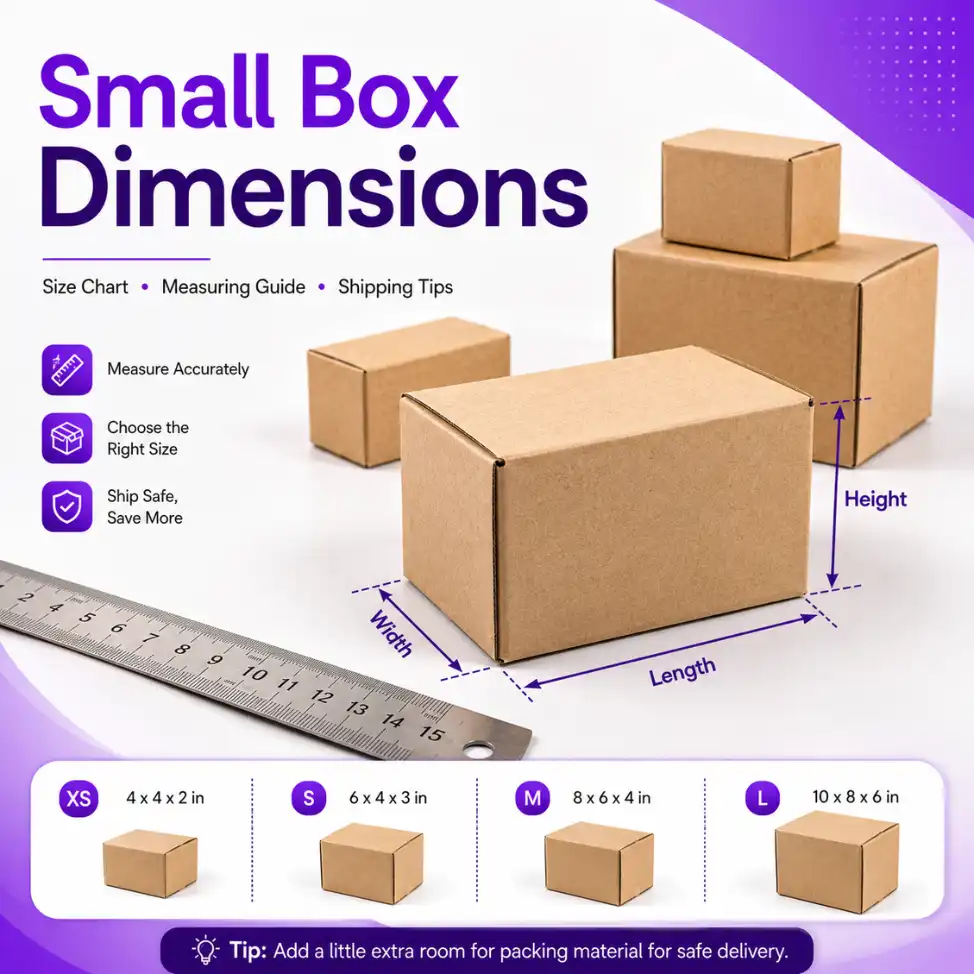
Dimensions are almost always written in one consistent order: Length × Width × Height (L × W × H). Get that order wrong when comparing boxes and you’ll order the wrong size — a surprisingly common mistake.
Read More: How Are Dimensions Listed
What Are Small Box Dimensions?
Small box dimensions describe the three measurements of a box, listed as Length × Width × Height, usually in inches, centimeters, or millimeters.
- Length — the longest side of the box’s opening
- Width — the shorter side of the box’s opening
- Height — how deep or tall the box stands once assembled
Simple enough — but here’s where most buyers get tripped up.
Internal vs. External Dimensions
- Internal dimensions are the usable space inside the box — what your product actually fits into.
- External dimensions are the full outer size of the box, including the cardboard walls. This is what carriers usually use to calculate shipping cost.
Usable Space vs. Material Thickness
The thicker the board (say, a heavy-duty corrugated wall versus a thin paperboard wall), the more it “eats into” the internal space. A box listed at 6 × 4 × 2 inches on the outside might only offer 5.7 × 3.7 × 1.8 inches on the inside once you account for wall thickness.
Buyer tip: Always confirm internal dimensions before ordering, especially if you’re packing a rigid product like a phone case, jar, or book. A box that looks right on paper can be too tight once the walls are factored in.
Why Small Box Dimensions Matter
Lower Shipping Cost
Carriers price many shipments by size, not just weight. A box that’s even slightly larger than it needs to be can bump you into a higher pricing tier.
Better Product Protection
Too much empty space means your product can shift, rattle, and get damaged in transit. Too little space means crushing or tearing. Correct dimensions strike the balance.
Improved Storage and Stacking
Boxes sized to a consistent standard stack cleanly on shelves and pallets, making warehouse space and fulfilment far more efficient.
Better Brand Presentation
A box that fits the product snugly looks intentional and premium. An oversized box with packing peanuts feels like an afterthought.
Less Material Waste
Right-sized boxes use less cardboard and less filler material — good for cost and for sustainability goals.
Improved Unboxing Experience
Customers notice when a box feels custom-fit. It’s a small detail that shapes how a brand is perceived.
Easier Handling and Fulfilment
Standardized, correctly sized boxes are faster to pack, label, scan, and ship — which matters at any order volume.
How to Measure a Small Box Correctly
- Measure the length — the longest edge of the box opening, left to right.
- Measure the width — the shorter edge, front to back.
- Measure the height (or depth) — from the base of the box straight up to the top edge.
- Record in inches, cm, and mm if you sell internationally or work with suppliers who use different units.
- Measure from the inside when you need to confirm your product will fit.
- Measure from the outside when you’re calculating shipping costs or carrier size limits.
Example: If your product is 5.5 × 3.5 × 1.5 inches, you’d typically look for an internal box size of around 5.75 × 3.75 × 1.75 inches — enough room for the product plus a thin layer of protective wrap, without excess empty space.
Small Box Size Chart
| Box Type | Dimensions (Inches) | Dimensions (CM) | Dimensions (MM) | Best For |
|---|---|---|---|---|
| Extra-small | 3 × 3 × 2 | 7.6 × 7.6 × 5.1 | 76 × 76 × 51 | Jewelry, small accessories |
| Small mailer | 4 × 4 × 2 | 10.2 × 10.2 × 5.1 | 102 × 102 × 51 | Rings, small cosmetics |
| Small product box | 5 × 4 × 2 | 12.7 × 10.2 × 5.1 | 127 × 102 × 51 | Skincare, small gift items |
| Small shipping box | 6 × 4 × 2 | 15.2 × 10.2 × 5.1 | 152 × 102 × 51 | Electronics accessories |
| Small cube box | 6 × 6 × 4 | 15.2 × 15.2 × 10.2 | 152 × 152 × 102 | Candles, mugs |
| Medium-small | 7 × 5 × 3 | 17.8 × 12.7 × 7.6 | 178 × 127 × 76 | Cosmetic sets |
| Small display box | 8 × 6 × 4 | 20.3 × 15.2 × 10.2 | 203 × 152 × 102 | Retail display packs |
| Small book box | 9 × 6 × 3 | 22.9 × 15.2 × 7.6 | 229 × 152 × 76 | Books, flat items |
| Small subscription box | 10 × 8 × 4 | 25.4 × 20.3 × 10.2 | 254 × 203 × 102 | Subscription bundles |
| Custom size | Made to product | Made to product | Made to product | Unique or branded products |
These are common reference sizes — actual dimensions can shift slightly depending on the manufacturer and material thickness.
Common Types of Small Boxes and Their Dimensions
Small Shipping Boxes
Sturdy corrugated boxes built to survive transit. Typically range from 4 × 4 × 2 to 10 × 8 × 4 inches. Best for e-commerce parcels.
Buyer tip: check your carrier’s dimensional weight rules before finalizing a size.
Small Mailer Boxes
Flat, self-locking boxes, often 6 × 4 × 2 to 9 × 6 × 2 inches. Great for apparel, small flat goods, and mail-order items.
Buyer tip: these ship efficiently but offer less cushioning — pair with a protective insert for fragile goods.
Small Product Boxes
Retail-ready boxes sized to the product itself, often 3 × 3 × 2 to 6 × 6 × 3 inches. Used for the primary packaging customers see on a shelf.
Buyer tip: get exact product measurements before finalizing size.
Small Tuck Top Boxes
Boxes with a fold-and-tuck closure, no tape needed. Common sizes: 4 × 4 × 2 to 8 × 6 × 3 inches. Ideal for cosmetics, supplements, and small retail goods.
Buyer tip: tuck top boxes print well and suit branded retail packaging.
Small Display Boxes
Counter-top or shelf-ready boxes, often 8 × 6 × 4 inches or larger. Used to showcase multiple units at retail.
Buyer tip: leave room for a printed header or window if the box will sit on a shelf.
Small Gift Boxes
Decorative boxes, commonly 5 × 5 × 2 to 8 × 6 × 3 inches. Used for gifting, sets, and premium unboxing. Buyer tip: rigid stock adds a premium feel for higher-end gifting.
Small Boxes with Window
Standard box styles with a die-cut window, often 4 × 4 × 2 to 8 × 6 × 3 inches. Great for showing off the product without opening the box.
Buyer tip: confirm window placement doesn’t cross a fold line.
Small Candle Boxes
Typically 3 × 3 × 3 to 6 × 6 × 4 inches, sized to the jar or tin.
Buyer tip: add slight extra height if your candle has a raised lid or label.
Small Book Boxes
Rectangular, flat-profile boxes, often 9 × 6 × 3 inches.
Buyer tip: measure the book’s spine width for accurate height.
Small Cosmetic Boxes
Compact boxes for serums, palettes, and skincare, usually 3 × 3 × 2 to 5 × 4 × 2 inches.
Buyer tip: consider moisture-resistant coating for liquid products.
Small Retail Boxes
General-purpose retail packaging, ranging from 4 × 4 × 2 to 8 × 6 × 4 inches.
Buyer tip: standardize a few sizes across your product line to simplify ordering and storage.
Small Box Dimensions for Shipping
Carriers don’t only charge by weight — many use dimensional weight to price shipments, especially for boxes that are large but light.
Dimensional Weight = Length × Width × Height ÷ DIM Divisor
If the dimensional weight is higher than the actual weight, the carrier typically charges based on the larger (dimensional) figure. This is exactly why an oversized box for a small, light product can end up costing more than a properly fitted one.
Shipping carriers generally calculate this using external dimensions, not internal ones, so the extra wall thickness of your box does factor into the cost.
DIM divisors and exact pricing rules change from carrier to carrier and get updated periodically, so always check current UPS, FedEx, or USPS guidelines before finalizing your shipping strategy — don’t rely on older rules you may have used in the past.
Standard vs. Custom Small Box Dimensions
| Factor | Standard Sizes | Custom Sizes |
|---|---|---|
| Best for | Low-volume orders, generic products | Unique shapes, branded products |
| Speed | Fast, off-the-shelf | Requires production lead time |
| Cost per unit | Lower for small orders | Better value at higher volume |
| Branding | Limited | Full control over fit and print |
| Waste | Can leave empty space | Sized to reduce waste |
| Best use case | Basic shipping, fast turnaround | Subscription boxes, retail display, premium branding |
Standard sizes work well when you need packaging fast, sell varied or generic products, or ship low volumes where custom tooling isn’t cost-effective.
Custom sizes make more sense when your product has an unusual shape, when branding matters, when you’re shipping at scale, or when reducing empty space and material waste is a priority.
Best Materials for Small Boxes
- Cardboard (paperboard) — lightweight, low-cost, good for retail boxes that don’t need heavy protection.
- Corrugated cardboard — layered for strength, the standard choice for shipping boxes.
- Kraft paperboard — natural, recyclable look, popular for eco-conscious branding.
- Rigid stock — thick, sturdy board used for premium gift and retail boxes.
- SBS paperboard (solid bleached sulfate) — smooth, printable surface ideal for cosmetics and retail packaging.
- E-flute corrugated — thin flute, strong yet compact, good for small product boxes.
- B-flute corrugated — slightly thicker flute, better cushioning for small shipping boxes.
As a general rule: lightweight paperboard is enough for retail display or gifting where the box isn’t the primary shipping container. Corrugated board is the better choice whenever the box travels through a shipping network on its own.
How to Choose the Right Small Box Size
- Measure your product accurately on all three sides
- Add space for inserts, tissue, or cushioning material
- Factor in the box’s material thickness, not just the product size
- Check your shipping carrier’s size and weight limits
- Think about how the box will look and stack on a retail shelf
- Request a sample before committing to a bulk order
- Avoid oversized packaging that inflates cost and waste
- Plan space for your logo, printing, or branding elements
Common Mistakes to Avoid
- Choosing based on external size instead of internal, usable size
- Ignoring the thickness of inserts or padding when sizing the box
- Leaving too much empty space, leading to product movement and damage
- Using thin material for fragile or heavy items
- Overstuffing the box, which stresses seams and can cause tearing
- Not checking dimensional weight before choosing a shipping box
- Skipping the sample stage before a bulk custom order
- Forgetting to leave room for branding or required labeling
Small Box Dimensions for Different Products
- Jewelry — 3 × 3 × 2 inches, snug-fit box with insert or foam
- Candles — 4 × 4 × 4 to 6 × 6 × 4 inches, matched to jar height
- Cosmetics — 3 × 3 × 2 to 5 × 4 × 2 inches, tuck top or SBS box
- Soaps — 4 × 3 × 2 inches, sleeve or tuck top style
- CBD products — 4 × 4 × 2 to 6 × 4 × 2 inches, tamper-evident closure
- Electronics accessories — 5 × 4 × 2 to 6 × 4 × 2 inches, corrugated for protection
- Books — 9 × 6 × 3 inches, rigid flat-pack box
- Subscription items — 10 × 8 × 4 inches, branded mailer box
- Gift items — 6 × 6 × 3 to 8 × 6 × 4 inches, rigid or gift-style box
- Retail samples — 3 × 3 × 2 inches, small display or mailer box
Why Custom Small Boxes Are Better for Brands
Once your product line is established, custom dimensions typically outperform standard sizing on every metric that matters — cost, protection, and brand perception.
We help brands move away from generic, one-size-fits-all packaging toward boxes built around their exact product. That includes:
- Custom sizes built to your product’s precise measurements
- Full custom printing, inside and out
- Logo placement and brand-consistent design
- Window cut-outs to showcase the product
- Custom inserts for a secure, premium fit
- Foil stamping and spot UV for standout finishes
- Embossing for a tactile, high-end feel
- Matte or gloss finishes to match your brand identity
- Eco-friendly, recyclable material options
- Wholesale rates that scale with your order volume
- Low minimum order quantities for smaller brands
- Fast, responsive support throughout the ordering process
Final Thoughts
Small box dimensions are never just measurements. They shape your shipping cost, how well your product survives the journey, how efficiently you store and stack inventory, how sustainable your packaging is, and how your brand feels the moment a customer opens the box.
Getting the size right — internal fit, external shipping cost, and material strength — pays off in fewer damaged returns, lower shipping bills, and a better first impression.
Ready to get your packaging dimensions right the first time? Reach out to us for a custom small box quote, built around your exact product, brand, and order volume.
FAQs
What are small box dimensions? Small box dimensions are the length, width, and height measurements of a compact box, usually written as L × W × H in inches, centimeters, or millimeters.
How do I measure a small box? Measure the length (longest side of the opening), width (shorter side), and height (depth from base to top edge). Measure inside the box to check product fit, and outside the box for shipping calculations.
Are box dimensions internal or external? It depends on the listing, so always check. Internal dimensions tell you the usable space for your product; external dimensions tell you the full outer size, which carriers typically use for shipping cost.
What is the most common small shipping box size? Sizes like 6 × 4 × 2 inches and 8 × 6 × 4 inches are widely used for small shipping boxes, though the “best” size always depends on the specific product being shipped.
What size small box is best for fragile products? Choose a box with enough internal room for cushioning material around the product, and use corrugated board rather than thin paperboard for extra impact protection.
Do small box dimensions affect shipping cost? Yes. Many carriers use dimensional weight, calculated from the box’s external dimensions, so an oversized box can cost more to ship even if the product itself is light.
Can I order custom small box dimensions? Yes. We build boxes to your exact product measurements, with custom printing, finishes, and branding options available at scale.
What material is best for small boxes? Lightweight paperboard works well for retail or gift packaging that won’t ship alone. Corrugated cardboard is the better choice for boxes that need to survive shipping and handling on their own.