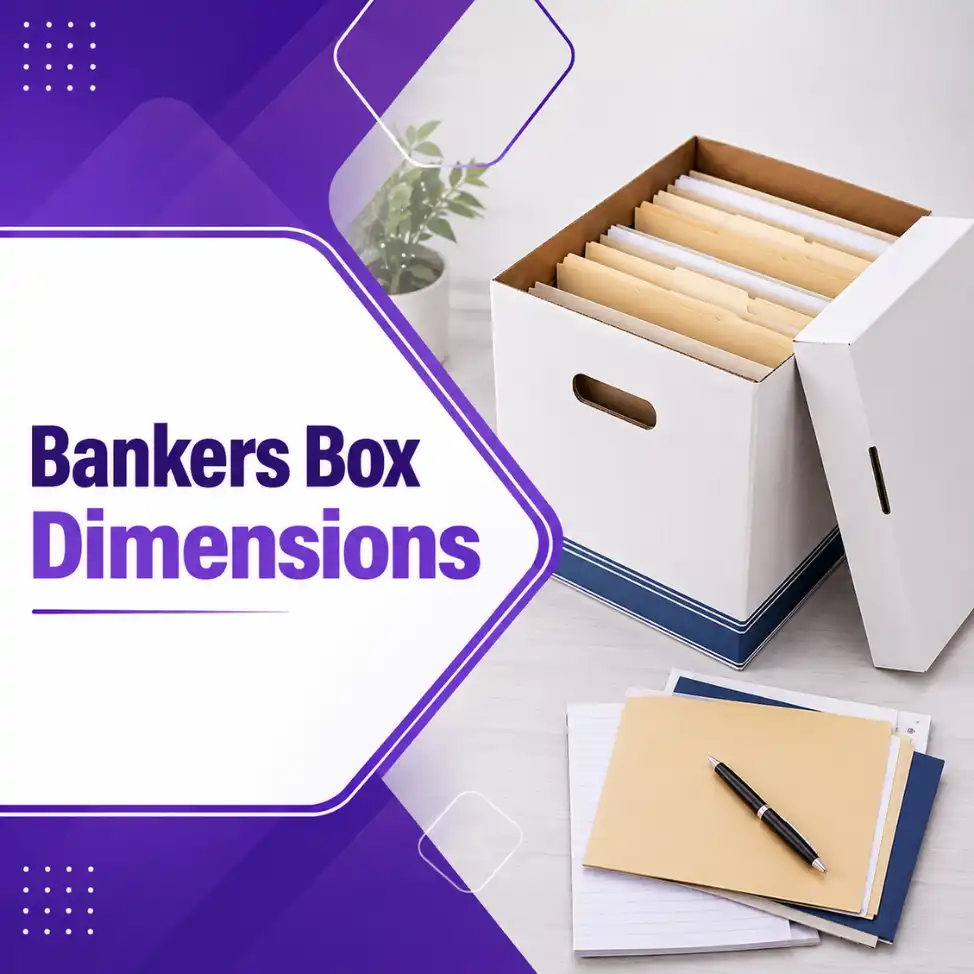
The standard bankers box (also called a file storage box) measures approximately 15 x 12 x 10 inches (38.1 x 30.5 x 25.4 cm / 381 x 305 x 254 mm) and is built to hold both letter-size and legal-size documents without folding. This size has become the industry default because it fits most office shelving, stacks safely, and matches standard paper dimensions used across the US.
But box dimensions vary depending on paper type, duty strength, and region, so let’s break down everything you need to know before buying or organizing storage for your files.
Bankers Box Size Chart
Here is a simple size comparison so you can quickly find the right box for your needs.
| Box Type | Inches (L x W x H) | Centimeters (L x W x H) | Best For |
|---|---|---|---|
| Standard Letter/Legal | 15 x 12 x 10 | 38.1 x 30.5 x 25.4 | Everyday office files |
| Small Storage Box | 12 x 10 x 9 | 30.5 x 25.4 x 22.9 | Light documents, limited shelf space |
| Heavy-Duty Box | 15 x 12 x 10 | 38.1 x 30.5 x 25.4 | Long-term archiving, stacking |
| Large Storage Box | 16-18 x 12-14 x 10-12 | 40.6-45.7 x 30.5-35.6 x 25.4-30.5 | Bulk records, oversized folders |
Keep in mind these numbers usually refer to external (outer) dimensions. The internal, usable space is typically half an inch to one inch smaller on each side once you account for the thickness of the cardboard walls. If you’re storing hanging folders or thick binders, always check internal dimensions rather than relying on the outer box size alone.
What Is a File Storage Box (Bankers Box)?
A file storage box, commonly referred to by the generic term “bankers box,” is a rectangular cardboard container designed to hold documents, folders, and general office items. It typically has a lift-off lid or a fold-in lid along with built-in handles for carrying. Note that Bankers Box is also a registered brand name used by certain manufacturers, so this article uses the term generically to describe the common file storage box style found across most office supply retailers, not one specific product line.
These boxes are widely used in offices, law firms, archives, schools, and homes because they are lightweight, stackable, and affordable.
Why Box Dimensions Matter
1. Document Protection
Paper that’s too large for a box tends to bend or crease at the edges, which can damage documents over time. Matching the box size to your paper size keeps everything flat and intact.
2. Shelf and Storage Fit
Most office shelving units are built around standard box dimensions. A box that’s even an inch too wide or tall may not fit properly, wasting shelf space or creating an unsafe stack.
3. Stacking Safety
Uniform dimensions let boxes stack evenly without leaning. This matters most in tall storage rooms, warehouses, or archive facilities where boxes are stacked four or five high.
4. Organization and Labeling
When all your boxes share the same footprint, it’s easier to label, sort, and locate files quickly, especially in large archive systems.
5. Moving and Shipping Costs
If you’re relocating an office or shipping records, box dimensions directly affect how many boxes fit into a vehicle or container, which can influence total shipping cost.
Internal vs External Dimensions: What’s the Difference
This is one detail most buyers overlook. The dimensions listed by most sellers refer to the external size of the box, meaning the measurement from outer wall to outer wall. The internal (usable) space is smaller because of the cardboard thickness itself.
For a standard 15 x 12 x 10 inch box, the internal usable space is often closer to 14.25 x 11.25 x 9.5 inches, though this varies slightly by manufacturer and cardboard thickness. This difference matters most when you’re fitting hanging file frames, binders, or rigid folders that need exact clearance. Always leave a small buffer rather than measuring your files to the exact external size of the box.
How Many Files or Folders Fit in a Standard Box
A rough guide for planning storage space:
- A standard 15 x 12 x 10 inch box typically holds around 1 linear foot of hanging files, which is roughly 25 to 30 standard file folders.
- For loose paper stacked flat rather than in folders, the same box can hold approximately 2,500 to 3,000 sheets of standard paper, depending on paper weight.
- Legal-size boxes hold slightly fewer folders per box due to the extra depth needed per folder, generally around 20 to 25 legal folders.
These numbers are estimates and will vary based on folder thickness, paper weight, and how tightly files are packed. As a general rule, leave a small gap at the top of the box rather than packing it completely full, since overpacked boxes are harder to close and more likely to tear.
Weight Capacity and Stacking Strength
Weight capacity is one of the most overlooked aspects of box dimensions, but it directly affects how safely you can store and stack files.
- Basic-duty boxes may hold up to around 25-35 lbs (11-16 kg) before the bottom risks sagging or tearing, though this varies by cardboard quality and brand.
- Many heavy-duty boxes can support approximately 40-65 lbs (18-29 kg), depending on the cardboard grade and construction.
- For stacking, many standard boxes are generally able to support two to three boxes stacked on top when placed on a flat, stable shelf, while heavy-duty versions may support four or more. Always check the specific manufacturer’s rating before stacking heavy loads.
If you’re archiving paper long-term, weight capacity matters more than most people expect, since a fully packed box of paper is heavier than it looks and a weak bottom seam can fail under sustained pressure.
Letter Size vs Legal Size vs A4 vs A5
Letter paper measures 8.5 x 11 inches (21.6 x 27.9 cm). This is the standard paper size used across the US and Canada for everyday documents.
Legal Size Paper
Legal paper measures 8.5 x 14 inches (21.6 x 35.6 cm), longer than letter size. Legal-size file storage boxes are built a bit deeper to fit this extra length without folding the paper.
A4 Size Paper
A4 is the international paper standard used across Europe, Asia, and most other regions. It measures 210 x 297 mm (8.27 x 11.69 inches), slightly narrower and longer than letter size.
A5 Size Paper
A5 is half the size of A4, measuring 148 x 210 mm (5.83 x 8.27 inches). It’s typically used for notebooks and booklets rather than standard office filing.
US vs UK/International Box Sizing
This is where a lot of confusion happens for businesses working across regions. US-made file storage boxes are built around letter and legal paper dimensions, while UK and other international suppliers typically design boxes around A4 and A5 standards. Since A4 paper is slightly longer and narrower than letter paper, a US-standard box will usually still fit A4 documents, but there may be a small gap on the width side and a slightly tighter fit on the length side. If your business operates internationally or handles both paper standards, it’s worth checking the internal dimensions of a box against your specific paper size rather than assuming a “standard” box will fit both equally well.
Basic-Duty vs Heavy-Duty Boxes
Basic-Duty Boxes
Made from lighter cardboard, best suited for short-term storage, lightweight documents, or infrequent handling. More affordable, but not built for heavy weight or repeated stacking.
Heavy-Duty Boxes
Built with thicker corrugated layers for long-term storage, frequent handling, and multi-box stacking. Ideal for archives, legal firms, and businesses storing records for several years.
Which One Should You Choose?
For short-term storage or infrequent handling, a basic-duty box is usually enough. For long-term archives or stacks more than two or three boxes high, heavy-duty boxes are worth the extra cost since they reduce the risk of collapse and document damage.
Measurement Conversion Guide
- 1 inch = 2.54 cm = 25.4 mm
- 10 inches = 25.4 cm = 254 mm
- 12 inches = 30.48 cm = 304.8 mm
- 15 inches = 38.1 cm = 381 mm
- 18 inches = 45.72 cm = 457.2 mm
When comparing boxes from different regions or suppliers, convert all measurements into one consistent unit before comparing, so you can judge fit accurately against your shelving or storage space.
Buying Checklist Before You Purchase
- Measure your documents first, especially for legal-size or A4 paperwork, to avoid folding.
- Check internal dimensions, not just external size, if you’re storing binders or hanging frames.
- Confirm your shelving unit’s depth and height before buying in bulk.
- Choose heavy-duty boxes if you plan to stack more than three boxes high.
- Estimate weight per box using the folder and paper counts above, rather than guessing.
- If operating internationally, verify whether A4-oriented dimensions suit your files better than standard letter-size boxes.
- Label every box clearly, since uniform sizing makes similar boxes hard to tell apart without labels.
Practical Uses and Storage Benefits
For Offices
Businesses use file storage boxes for financial records, employee files, contracts, and general paperwork. Uniform sizing makes filing rooms easier to organize.
For Law Firms
Legal offices handle large volumes of paperwork that must be preserved for years. Legal-size boxes prevent folding or bending of important legal documents.
For Home Organization
Many people use these boxes at home for tax records, old bills, photographs, or seasonal items, thanks to their sturdy build and closet-friendly footprint.
For Moving and Relocation
Stackable design and built-in handles make these boxes a practical choice when relocating offices or homes, particularly for books and lightweight belongings.
For Archival Storage
Businesses retaining records for compliance or legal reasons often rely on heavy-duty boxes, which hold up well over extended storage periods.
Conclusion
Choosing the right file storage box comes down to more than just picking whatever’s available at the store. Once you understand the difference between internal and external dimensions, how paper size affects box fit, and how weight capacity influences stacking safety, you can build a storage system that protects your documents and makes the most of your available space. Whether you’re organizing a law firm archive or clearing out a home office, matching the box to your actual needs saves time, money, and damaged paperwork down the line.
Frequently Asked Questions
1. What is the standard size of a bankers box or file storage box?
Most standard file storage boxes measure around 15 x 12 x 10 inches (38.1 x 30.5 x 25.4 cm) on the outside, with slightly smaller internal usable space.
2. Can a standard box hold A4 paper?
Yes, generally. Since A4 paper is slightly longer and narrower than letter-size paper, it usually fits with a small gap on one side, but it’s worth checking internal dimensions if the fit needs to be precise.
3. What is the difference between letter-size and legal-size storage boxes?
Legal-size boxes are built deeper to fit legal paper (8.5 x 14 inches) compared to letter paper (8.5 x 11 inches), preventing the paper from folding.
4. How much weight can a standard file storage box hold?
It varies by brand and construction, but basic-duty boxes may hold around 25-35 lbs, while many heavy-duty boxes can support roughly 40-65 lbs, depending on cardboard thickness and grade. Check the specific product’s rating for exact limits.
5. Are heavy-duty boxes worth the extra cost?
If you’re storing documents long-term or stacking several boxes on top of each other, heavy-duty boxes are a worthwhile investment since they reduce the risk of sagging, tearing, or collapsing.
Need custom file storage boxes in your required size? Variety Packaging can help you create durable cardboard and corrugated storage boxes with custom printing, handles, lids, and bulk order options.