Anyone who’s packed a cake into a box that was just a little too big or a little too small knows the feeling. The frosting smears, the lid won’t sit flat, and suddenly a beautiful dessert looks like it took a rough ride to get there.
Bakery box dimensions get overlooked more than they should. Most people treat box size as an afterthought, something you figure out at checkout rather than something you plan around. But the right dimensions protect the product, keep it looking the way it’s supposed to look, and honestly, make your bakery look more professional the second the box is opened.
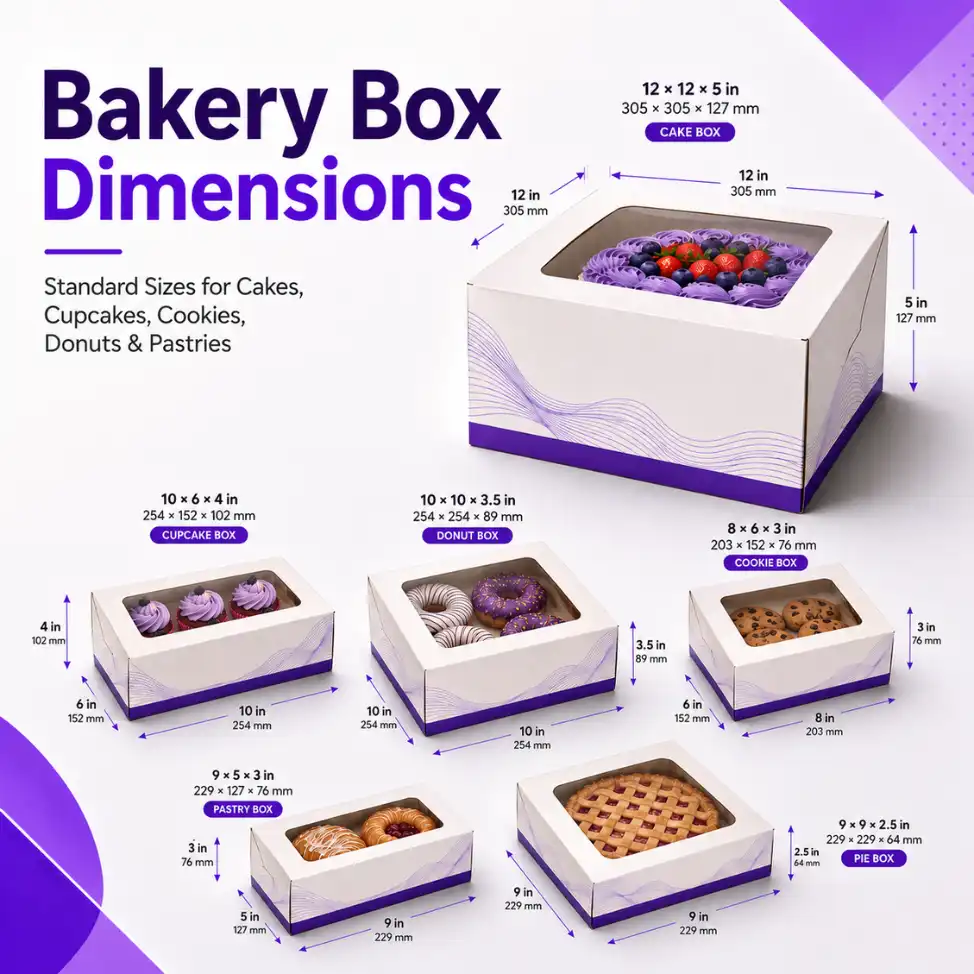
Standard Bakery Box Size Chart
Before getting into the details for each product type, here’s a quick reference chart. These are commonly used sizes across the bakery packaging industry, though exact dimensions can vary slightly between suppliers.
| Product Type | Common Size (L x W x H, inches) |
|---|---|
| 6″ round cake | 8″ x 8″ x 5″ |
| 8″ round cake | 10″ x 10″ x 5″ |
| 10″ round cake | 12″ x 12″ x 6″ |
| Quarter sheet cake | 13″ x 9″ x 4″ |
| Half sheet cake | 19″ x 14″ x 4″ |
| Full sheet cake | 26″ x 18″ x 5″ |
| 4 cupcakes | 7″ x 7″ x 4″ |
| 6 cupcakes | 10″ x 7″ x 4″ |
| 12 cupcakes | 14″ x 10″ x 4″ |
| 24 cupcakes | 19″ x 14″ x 4″ |
| Small pastry box | 8″ x 8″ x 3″ |
| Dozen cookie box | 9″ x 9″ x 2.5″ |
| Standard loaf | 10″ x 4″ x 4″ |
| Standard pie (9″) | 10″ x 10″ x 4″ |
Think of this as a starting point rather than a rulebook. The sections below explain the reasoning behind these numbers, and when it makes sense to size up, down, or go custom.
How Are Bakery Boxes Measured?
Bakery boxes are almost always measured as Length x Width x Height, in inches, based on the inside usable space of the box.
A few things worth knowing before you start measuring:
- Length and width describe the footprint of the box the space your product sits in.
- Height is measured from the base to where the lid closes, which matters a lot for anything with frosting, toppers, or piped decoration.
- Most suppliers list interior dimensions, not the outer cardboard size, since that’s what actually determines whether your product fits.
The general rule bakers use is to leave half an inch to one inch of clearance around the product on all sides. That’s enough room to close the box without pressing into the item, but not so much room that the product can slide around during handling.
Standard Cake Box Dimensions
Cake boxes need the most thought out of any category, mainly because cakes vary so much in height depending on frosting style, tiers, and decoration.
Typical sizing by cake diameter:
- 6-inch round cake: 8″ x 8″ x 5″
- 8-inch round cake: 10″ x 10″ x 5″
- 10-inch round cake: 12″ x 12″ x 6″
- 12-inch round cake: 14″ x 14″ x 6″
These numbers assume a standard buttercream or fondant finish. If a cake has a tall topper, sugar flowers, or piped borders that rise above the top edge, it’s worth adding an extra inch or two of height. A cake that measures 5 inches tall including its topper needs more than a 5-inch box — the topper needs its own breathing room too.
Tiered cakes are their own category. A two-tier cake can easily need a box 14 to 16 inches tall, and taller creations sometimes require fully custom heights. Rather than estimating based on tier count, it’s more reliable to measure the finished cake directly, topper included, before choosing a box.
Cupcake Box Dimensions by Quantity
Cupcake boxes are sized around quantity and insert grid rather than the cupcake dimensions alone, since the insert is what actually holds each cupcake in place.
Common sizes:
- 4 cupcakes: 7″ x 7″ x 4″
- 6 cupcakes: 10″ x 7″ x 4″
- 12 cupcakes: 14″ x 10″ x 4″ (usually a 3×4 insert)
- 24 cupcakes: 19″ x 14″ x 4″
Height stays fairly consistent at 4 inches for standard cupcakes, but jumbo cupcakes or ones with tall swirled frosting often need 4.5 to 5 inches instead. Without that extra height, frosting ends up flattened against the lid before the box even reaches the customer.
It’s also worth double-checking whether an insert is included with the box or sold separately. A cupcake box without a proper insert lets cupcakes knock into each other, which is one of the most common causes of frosting damage in transit.
Pastry and Donut Box Dimensions
Pastries and donuts are usually boxed as assortments, so dimensions are built around quantity and layout rather than a single item’s size.
Typical ranges:
- Small pastry box (4-6 pieces): 8″ x 8″ x 3″
- Medium pastry box (half dozen): 10″ x 10″ x 3″
- Large pastry/donut box (dozen): 14″ x 10″ x 4″
Donut boxes tend to stay shallow, usually around 3 to 3.5 inches, since donuts are low-profile and don’t need much clearance. Pastries with height cream puffs, filled croissants, or anything with a domed top need slightly taller boxes, closer to 4 inches, to avoid crushing the top of the item.
Cookie and Macaron Box Dimensions
Cookies and macarons cover a wide size range, from single-layer gift boxes to stacked, multi-dozen orders.
- Small cookie gift box: 6″ x 6″ x 2″
- Standard dozen cookie box: 9″ x 9″ x 2.5″
- Stacked/layered cookie box: 8″ x 8″ x 4″, used with parchment or dividers between layers
Macaron boxes are a bit more specific, since macarons are delicate and usually packed in individual insert slots. A standard 12-macaron box runs around 8″ x 6″ x 2″, with insert trays that keep each shell from touching its neighbor.
For decorated cookies with royal icing, height matters more than it seems. Icing can take a day or more to fully harden, and even icing that looks dry can smudge under light pressure. Adding an extra half-inch of clearance for decorated cookies avoids a lot of avoidable damage.
Bread and Loaf Box Dimensions
Bread packaging works a little differently, since bread needs airflow more than it needs a snug fit. Trapped steam leads to sogginess, so many bread boxes use perforated designs or open ends.
Typical dimensions:
- Baguettes: long boxes around 16″ x 4″ x 4″, often with open or perforated ends
- Round artisan loaves (boules): roughly 8″ x 8″ x 6″
- Sliced sandwich loaves: around 10″ x 4″ x 4″
Because bread shapes vary so much depending on the recipe and baking style, this is one of the categories where bakeries most often end up needing custom sizing.
Pie and Sheet Cake Box Sizes
Pies and sheet cakes are grouped together here because both are typically flat, wide items that need a shallow but wide box.
Pie boxes are usually sized to the pie diameter plus a bit of edge clearance:
- 8-inch pie: 9″ x 9″ x 4″
- 9-inch pie: 10″ x 10″ x 4″
- 10-inch pie: 11″ x 11″ x 4″
Sheet cake boxes follow standard bakery sizing conventions:
- Quarter sheet: 13″ x 9″ x 4″
- Half sheet: 19″ x 14″ x 4″
- Full sheet: 26″ x 18″ x 5″
Both categories benefit from a firm, flat base, since a weak bottom panel can flex under the weight of a full sheet cake or a heavily filled pie and cause cracking or sliding.
How to Choose the Right Bakery Box Size
A few steps make this process a lot less guesswork-driven:
- Measure the widest point of the product, not just the base. Piped borders, sugar flowers, and drizzle often extend past the base width.
- Measure total height, including any topper or garnish.
- Add clearance — around 0.5″ to 1″ on each side for cakes and pastries, slightly less for cookies and bread.
- Factor in the insert or liner, since it takes up space inside the box too.
- Test with your most decorated version of the product, not the simplest one. It’s a lot easier to have a bit of extra room around a plain cake than to crush a fully decorated one.
If you’re choosing boxes for a whole product line rather than a single item, size around the largest and most elaborate version in that line. That one decision prevents most repeat sizing issues down the road.
Custom Bakery Box Dimensions
Standard sizes cover most situations, but they don’t cover everything. Custom dimensions make sense when:
- A product has a non-standard or sculpted shape
- You’re building a specific brand look with unique proportions or window cutouts
- Your products consistently fall between standard sizes, causing recurring waste or damage
- Items are shipped rather than hand-delivered and need extra structural support
When requesting a custom size, it helps to give your supplier three things: the exact measurements of the finished product (topper and all), how much clearance you’d like, and how the box will be handled — flat pickup, stacked delivery, or long-distance shipping all call for slightly different structural choices.
A supplier who asks follow-up questions about handling and use case is usually a good sign. If they don’t ask, it’s worth bringing it up yourself before placing a bulk order.
Common Bakery Box Sizing Mistakes
A handful of mistakes come up again and again:
- Using one box size for every version of a product. A “plain” cake and a “deluxe” version with piping or a topper often need different heights.
- Ignoring insert dimensions. The outer box might be correct, but the wrong insert still leaves products loose and sliding.
- Skipping a test run. Boxing a single sample before ordering in bulk catches problems before they turn into a 500-box issue.
- Not accounting for stacking during delivery. If boxes get stacked, the lid needs to handle weight from above without caving in — sometimes this calls for a sturdier board rather than a size change.
- Forgetting about height for toppers and decoration. This is the single most common cause of damaged cakes and cookies in transit.
Final Thoughts
Bakery box dimensions might not be the most exciting part of running a bakery, but they quietly affect nearly everything how products hold up during transport, how they look when the box is opened, and how customers perceive the quality of your work. None of it requires guesswork. Measure the actual product, account for toppers and decoration, and choose a box that gives it just enough room to stay in place without being crushed.
Whether you stick with standard sizes or move toward fully custom bakery packaging, the goal is the same: a box that protects the product and supports the presentation, without ever becoming the thing customers notice first.
FAQs
What is the standard size for a cake box?
It depends on the cake’s diameter and finish, but common sizes are 8x8x5 for 6-inch cakes, 10x10x5 for 8-inch cakes, and 12x12x6 for 10-inch cakes. Height should always account for toppers and piped decoration.
What size box fits a dozen cupcakes?
A 14″ x 10″ x 4″ box with a proper insert is standard for a dozen regular-sized cupcakes. Jumbo cupcakes usually need a bit more height.
How much clearance should a bakery box have around the product?
Generally 0.5″ to 1″ on each side — enough to close the lid comfortably without pressing on the item, but not so much that the product can shift.
Do tiered cakes need special box heights?
Yes. Tiered cakes typically need boxes 14 to 16 inches tall or more, depending on the number of tiers and any topper. Measuring the finished cake is more reliable than estimating by tier count.
What size box works for a 9-inch pie?
A 10″ x 10″ x 4″ box is standard for a 9-inch pie, allowing enough edge clearance without excess empty space.
Is it worth ordering custom bakery box dimensions?
For signature products, recurring sizing issues, or brand-focused packaging, yes. Custom sizing reduces product damage and improves the unboxing experience, which often pays for itself through fewer replacements and better customer feedback.
What size boxes are best for bread?
It depends on the loaf shape — long, narrow boxes suit baguettes, while boxes closer to 8x8x6 work well for round artisan loaves. Ventilation matters as much as size for keeping bread fresh.