Paper size may look like a small detail, but in printing, packaging, and business communication, it affects almost everything: layout, margins, folding, trimming, file setup, mailing costs, packaging inserts, and final print quality. In the United States, one paper format appears more than any other in offices, schools, print shops, marketing departments, and packaging production rooms: Letter paper size.
For many people, Letter size paper is simply “regular printer paper.” However, for graphic designers, commercial printers, packaging companies, and business owners, understanding the exact measurements and printing requirements of this sheet is essential. A product manual, warranty card, instruction sheet, flyer, corporate document, or packaging insert that is set up incorrectly can lead to scaling issues, cropped artwork, poor alignment, or wasted production time.
What Is Letter Paper Size?
Letter paper size is a standard paper format widely used in the United States for business documents, office printing, school assignments, forms, reports, flyers, manuals, and printed inserts. It measures 8.5 inches wide by 11 inches tall.
In simple terms, Letter size paper is the everyday sheet most American printers, copiers, and office supplies are designed to handle. It is commonly used for:
- Business letters
- Invoices
- Resumes
- Office reports
- School worksheets
- Marketing flyers
- Product information sheets
- Packaging inserts
- Instruction manuals
- Shipping documents
In the printing industry, this format is important because it gives designers and printers a predictable working area. When a file is designed for Letter paper, the printer knows the expected page size, trim area, margins, bleed, and final output dimensions.
Letter paper is also part of the broader US paper standards system, which differs from the international ISO system used in many other countries. That is why the question “What Is Letter Paper Size?” often comes up when businesses prepare artwork for both American and international markets.
Letter Paper Size Dimensions
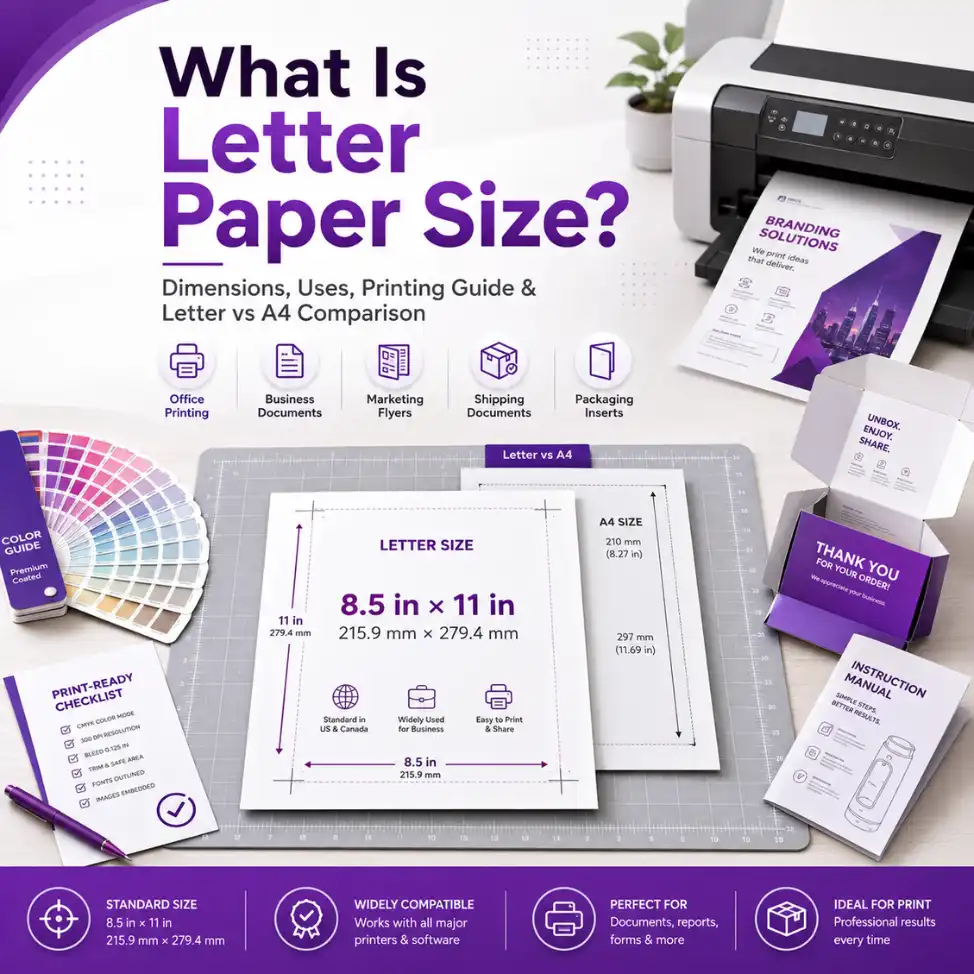
The standard US Letter paper size is 8.5 × 11 inches. In metric units, it equals 215.9 × 279.4 millimeters or 21.59 × 27.94 centimeters.
For digital design, pixel dimensions depend on the resolution. A file designed at 72 DPI is suitable for screen viewing, while 300 DPI is the preferred standard for high-quality print production.
| Measurement Type | Letter Paper Size |
|---|---|
| Inches | 8.5 × 11 in |
| Millimeters | 215.9 × 279.4 mm |
| Centimeters | 21.59 × 27.94 cm |
| Pixels at 72 DPI | 612 × 792 px |
| Pixels at 150 DPI | 1275 × 1650 px |
| Pixels at 300 DPI | 2550 × 3300 px |
For professional printing on Letter paper, 300 DPI is usually recommended for sharp text, clean images, and detailed graphics. Lower resolutions can work for internal office printing, but they may look soft or pixelated in commercial print production.
Why Letter Size Is the Standard Paper Size in the USA
Letter size paper became the common paper format in the United States through long-term use in business, education, government paperwork, and office printing. Unlike the ISO A-series paper system, which is based on a consistent mathematical ratio, US paper standards developed around practical office and printing needs.
Business Use
Most American companies use Letter size paper for contracts, reports, proposals, invoices, presentations, and company forms. Office printers, file folders, binders, envelopes, and filing cabinets are commonly built around this size.
Educational Use
Schools, colleges, and universities across the United States rely on Letter size paper for worksheets, assignments, handouts, exams, lesson plans, and printed study materials. This makes it familiar to students and educators from an early age.
Government Documentation
Many federal, state, and local documents are formatted for Letter paper. Applications, permits, notices, public forms, and administrative paperwork commonly use this standard format.
Printing Convenience
Because Letter paper is so common in the USA, it is easy to source, affordable, and compatible with most printers and copiers. This makes it a practical choice for both small print runs and large-volume document printing.
Common Applications of Letter Paper Size
Letter paper is used across many industries because it offers enough space for text, images, tables, branding, and structured layouts. In packaging and printing, it is especially useful for materials that need to be clear, readable, and cost-effective.
Business Documents
Business documents are one of the most common uses for Letter size paper. Companies use it for contracts, internal reports, proposals, invoices, estimates, HR forms, training materials, and meeting handouts.
A printing company may produce thousands of Letter-sized documents for corporate clients each week. Clean margins, consistent headers, and readable typography are important because these documents often represent the company’s professionalism.
Office Printing
Letter paper is the default size for most office printing in the United States. From daily memos to financial statements, office teams rely on this format because it works with standard printers, folders, binders, and mailing systems.
For office printing, paper weight often ranges from 20 lb bond for everyday use to heavier text stock for presentations or client-facing documents.
Educational Materials
Teachers and educators use Letter paper for lesson plans, classroom handouts, worksheets, reading packets, and student assignments. The size is easy to copy, staple, hole-punch, and organize.
For educational publishers, Letter size can also be used for workbooks, test prep materials, and downloadable PDFs.
Marketing Flyers
Letter paper is a popular choice for flyer printing because it provides enough space for a headline, offer, product image, contact details, and call-to-action. A restaurant menu flyer, real estate handout, event announcement, or product promotion can all be designed effectively on an 8.5 × 11 sheet.
For professional flyer printing, designers often add a 0.125-inch bleed on all sides if the artwork extends to the edge.
Product Catalogs
Small product catalogs, line sheets, and sales sheets are often created on Letter size paper. Businesses use them to showcase product images, pricing, specifications, and ordering details.
In packaging and retail industries, Letter-sized catalog pages can be used by sales representatives, trade show teams, and wholesale buyers.
Packaging Inserts
Packaging inserts are an important part of customer experience. A Letter-sized sheet can be printed and folded into a box as a thank-you note, product guide, warranty card, promotional insert, or brand story.
For ecommerce packaging, this format is practical because one sheet can be folded into halves or thirds depending on the box size.
Product Information Sheets
Product information sheets often include ingredients, specifications, safety details, assembly notes, or care instructions. Letter paper gives enough space for structured content without making the sheet feel crowded.
For cosmetics, electronics, food products, supplements, and consumer goods, clear product information helps customers understand the item and use it correctly.
Shipping Documentation
Packing slips, shipping forms, return instructions, invoices, and delivery notes are often printed on Letter paper. Warehouses and fulfillment centers use this format because it fits standard printers and document pouches.
In packaging workflows, accurate shipping documentation reduces errors and improves order handling.
Instruction Manuals
Many instruction manuals start as Letter-sized layouts before being folded, trimmed, stapled, or inserted into packaging. This is common for appliances, toys, electronics, tools, furniture parts, and health-related products.
When designing manuals, printers must consider text size, folding panels, binding style, and final insert dimensions.
Why Letter Paper Size Matters in Commercial Printing
In commercial printing, paper size is not just a layout preference. It affects the entire production process, from artwork setup to finishing.
Print Alignment
Correct paper size helps ensure that text, images, logos, and design elements print in the right position. If a file is set up as A4 but printed on Letter paper, the artwork may shift, shrink, or crop.
Cost Efficiency
Letter paper is widely available in the United States, which can make it cost-effective for many print jobs. Using a standard size reduces special cutting, setup changes, and material waste.
Design Consistency
When all documents, inserts, flyers, and manuals follow a consistent paper format, the brand looks more organized. This matters for businesses that print multiple materials, such as brochures, product sheets, catalogs, and packaging paperwork.
Print Production Workflows
Commercial printers rely on accurate file setup. Page size, bleed, margins, color mode, and resolution must match the final product. A correctly prepared Letter-size file helps avoid delays, reprints, and extra proofing rounds.
File Setup
Print-ready files should usually be exported as PDF with embedded fonts, high-resolution images, proper bleed, and correct trim size. For Letter paper, the final trim size is 8.5 × 11 inches.
Choosing the wrong size can create problems such as uneven borders, missing text, distorted images, or artwork that does not line up with folds or trims.
Letter Paper Size vs A4 Paper
Letter and A4 are similar, but they are not the same. Letter is the common standard in the United States, while A4 is used in most international markets.
| Feature | Letter Paper | A4 Paper |
|---|---|---|
| Dimensions in Inches | 8.5 × 11 in | 8.27 × 11.69 in |
| Dimensions in Millimeters | 215.9 × 279.4 mm | 210 × 297 mm |
| Main Regions Used | United States, Canada, parts of North America | Europe, Asia, Australia, and many international markets |
| Width | Slightly wider | Slightly narrower |
| Height | Shorter | Taller |
| Printing Compatibility | Standard for US office and business printing | Standard for international document printing |
| Advantages | Common in USA, easy to source, office-friendly | International standard, consistent ISO ratio |
| Common Applications | Business documents, flyers, forms, packaging inserts | International reports, documents, manuals, forms |
The main challenge when converting between Letter and A4 is proportion. A4 is taller and slightly narrower than Letter. If a design is moved from one format to the other without adjustment, the layout may not fit correctly.
For example, a brochure designed on A4 may have bottom text that gets cropped when printed on Letter paper. On the other hand, a Letter-size flyer printed on A4 may leave unexpected white space. Designers should resize the document properly instead of relying on automatic scaling.
Letter Paper Size for Packaging and Product Inserts
Letter paper plays a useful role in packaging because it can be printed, folded, trimmed, and inserted into many types of product boxes. Packaging companies often use Letter-sized sheets for materials that need more information than a small label can hold.
Common Letter-sized packaging materials include:
- Product manuals
- Warranty documents
- Assembly instructions
- Safety sheets
- Marketing inserts
- Product specification sheets
- Care instructions
- Return instructions
- Promotional coupons
For example, an electronics brand may include a folded Letter-size instruction manual inside a custom product box. A cosmetics company may use a Letter-sized insert to explain product benefits, ingredients, and usage directions. A furniture hardware brand may print assembly steps on Letter paper and fold the sheet into the packaging.
For packaging projects, Variety Packaging can help businesses prepare custom printed inserts, product information sheets, instruction manuals, and branded packaging materials that match the size, style, and structure of the final box.
Best Practices for Printing on Letter Paper
To get clean, professional results, designers and businesses should prepare Letter-size artwork carefully.
Use the Correct Document Size
Set your file to 8.5 × 11 inches before designing. Do not design in A4 and assume it will print perfectly on Letter paper.
Add Bleed When Needed
If the artwork extends to the edge, add a standard bleed of 0.125 inches on each side. This means the full bleed size becomes 8.75 × 11.25 inches.
Keep Safe Margins
Keep important text and logos away from the trim edge. A safe zone of at least 0.25 inches is recommended for most designs.
Export Print-Ready PDFs
PDF is the preferred format for commercial printing. Export with fonts embedded, images at 300 DPI, and bleed included when required.
Use CMYK for Print
For professional printing, CMYK color mode is usually preferred. RGB colors may look bright on screen but can shift when printed.
Check Image Resolution
Use high-resolution images to avoid blurry results. For Letter paper printing, 300 DPI is the standard for quality output.
Proof Before Production
Always review a digital proof and, when possible, request a printed proof before large-volume production.
Common Printing Mistakes to Avoid
Even experienced teams can run into problems when page size is not handled correctly.
Incorrect Page Setup
Designing on the wrong canvas size can affect the entire print job. Always confirm the document is set to 8.5 × 11 inches for US Letter.
A4 vs Letter Confusion
A4 and Letter look similar but have different dimensions. Check the final market before preparing artwork.
Scaling Issues
Automatic scaling can shrink or stretch the design. Instead of using “fit to page,” adjust the layout manually for the correct paper size.
Cropping Problems
Artwork near the edge can be cut off during trimming. Use bleed and safe zones to protect important content.
Margin Errors
Margins that are too narrow can make a document hard to read or difficult to print. Use consistent spacing around text and images.
Low-Resolution Graphics
Images copied from websites are often too low in resolution for printing. Use original high-quality images whenever possible.
Frequently Asked Questions
1. What is Letter paper size in inches?
Letter paper size in inches is 8.5 × 11 inches. It is the standard paper size used for most office printing, business documents, school materials, flyers, and forms in the United States.
2. What is Letter paper size in mm?
Letter paper size in millimeters is 215.9 × 279.4 mm. This measurement is useful when preparing print-ready artwork, especially for designers working with metric units.
3. What is Letter paper size in cm?
Letter paper size in centimeters is 21.59 × 27.94 cm. This is the metric conversion of the standard 8.5 × 11 inch sheet.
4. Is Letter paper the same as A4?
No, Letter paper is not the same as A4. Letter measures 8.5 × 11 inches, while A4 measures 8.27 × 11.69 inches. A4 is slightly narrower and taller than Letter.
5. Why does the USA use Letter paper?
The USA uses Letter paper because it became the standard through business, office, education, and government use. Printers, folders, binders, filing systems, and office supplies in the United States are commonly designed around this size.
6. Which paper size is best for printing?
For most US business and office printing, Letter size is the best choice. For international documents, A4 may be more suitable. For packaging inserts, the best size depends on the box dimensions, folding style, and amount of information needed.
7. Can A4 be printed on Letter paper?
Yes, A4 can be printed on Letter paper, but the design may need scaling or layout adjustment. Because A4 is taller and narrower, printing it directly on Letter paper can cause cropping or unwanted white space.
8. What paper size should I use for packaging inserts?
Letter paper is a practical choice for packaging inserts when you need space for instructions, product details, warranty information, or marketing content. However, the final insert size should match the packaging structure and folding requirements.
9. What resolution is best for Letter paper printing?
For high-quality Letter paper printing, 300 DPI is recommended. At 300 DPI, a Letter-size design should be 2550 × 3300 pixels.
10. Do I need bleed for Letter-size printing?
You need bleed if the design extends to the edge of the paper. A standard bleed is 0.125 inches on all sides. If your design has a white border, bleed may not be necessary.
11. Is Letter paper good for brochures?
Yes, Letter paper is commonly used for brochures, especially tri-fold brochures. A standard 8.5 × 11 sheet can be folded into three panels for marketing, product, or service information.
12. Can Letter paper be used for product manuals?
Yes, Letter paper is often used for product manuals, instruction sheets, assembly guides, and warranty documents. It can be folded, stapled, trimmed, or inserted into product packaging.
Conclusion
Letter paper size is the standard paper format for everyday printing in the United States. Measuring 8.5 × 11 inches, it is used for business documents, office printing, educational materials, marketing flyers, product catalogs, shipping paperwork, packaging inserts, and instruction manuals.
For commercial printing and packaging production, using the correct paper size helps avoid layout errors, cropping problems, scaling issues, and unnecessary production delays. Whether you are preparing a corporate document, a product information sheet, or a custom packaging insert, accurate file setup makes the final print cleaner and more professional.
If your business needs professional printing, packaging inserts, custom printed materials, product manuals, or packaging solutions, Variety Packaging can help you prepare print-ready designs that match your product, brand, and production requirements.