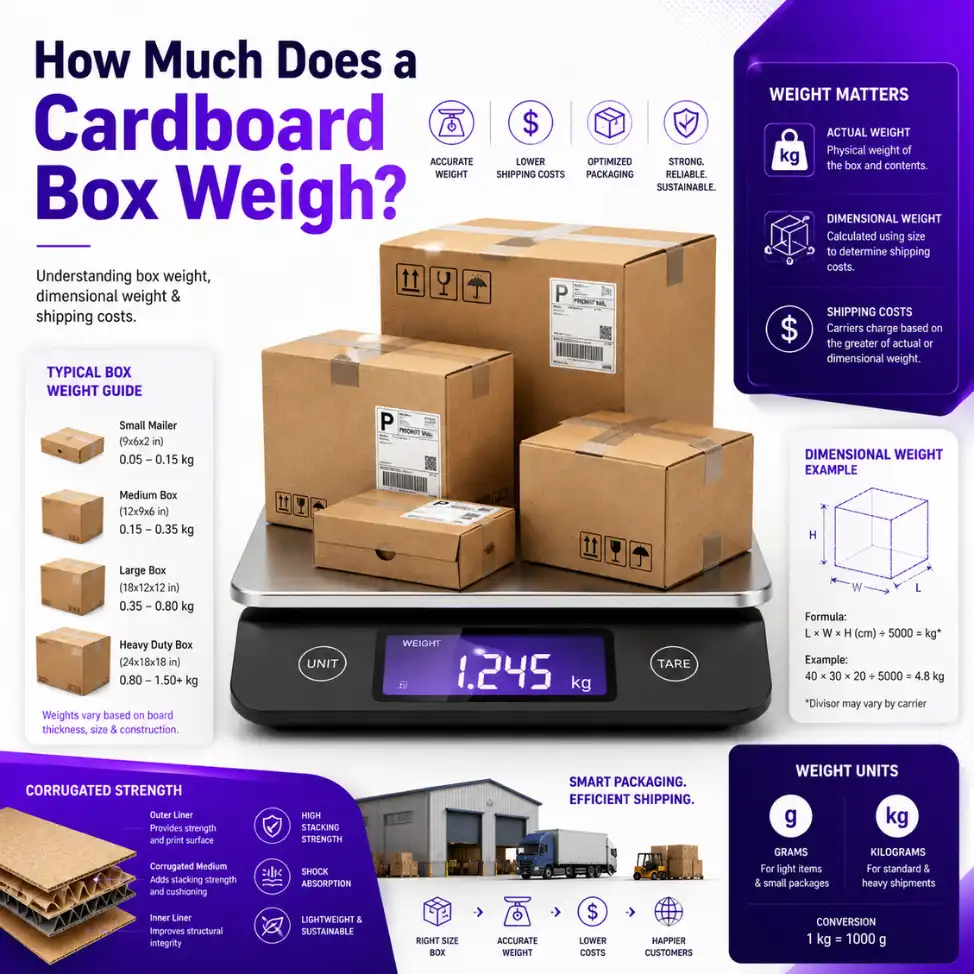
The weight of a cardboard box depends on its size, flute type, GSM, wall thickness, paper grade, and structural design. A small mailer box may weigh around 38–48 grams, a medium shipping box may weigh 220–255 grams, while a heavy-duty double-wall carton can weigh more than 1,300 grams.
For e-commerce brands, logistics managers, and packaging buyers, cardboard box weight is not just a small technical detail. It affects shipping costs, warehouse handling, dimensional weight, product protection, and sustainability goals. A box that is too heavy can quietly increase freight costs, while a box that is too light may fail during storage or transit.
This guide explains cardboard box weight in a practical and technical way, including average weights, calculation formulas, flute types, strength tests, dimensional weight, and strategies for reducing unnecessary packaging weight.
Average Cardboard Box Weight by Size
| Box Type | Common Size | Material Type | Average Empty Weight |
|---|---|---|---|
| Small Subscription Mailer | 6 × 6 × 2 in | Single-wall E-flute | 38–48 g |
| Medium Shipping Box | 12 × 12 × 10 in | Single-wall C-flute | 220–255 g |
| Large Distribution Carton | 18 × 18 × 16 in | Heavy-duty single-wall | 610–685 g |
| Heavy-Duty Cargo Box | 24 × 20 × 20 in | Double-wall BC-flute | 1,350–1,580 g |
These are average estimates. The final cardboard box weight can change based on paper GSM, flute profile, liner quality, moisture level, adhesive, printing, coatings, inserts, and manufacturing style.
What Is Cardboard Box Weight?
Cardboard box weight usually refers to the empty tare weight of the box. This means the physical weight of a finished cardboard container before adding products, void fill, labels, sealing tape, or shipping documents.
In packaging and logistics, tare weight matters because it helps businesses separate the weight of the product from the weight of the packaging. This is important for shipping cost control, warehouse planning, inventory movement, and material optimization.
For one shipment, a 50-gram difference may seem small. But for a business shipping 500,000 orders a year, that same 50 grams becomes 25,000 kilograms of extra packaging weight moving through the supply chain. That extra weight can affect freight rates, fuel usage, and total logistics cost.
Cardboard Box Weight vs. Box Dimensions
Many businesses confuse box dimensions with box weight, but they are different measurements.
Box dimensions describe the physical size of the container. They are usually measured as:
Length × Width × Height
Dimensions tell you how much space the box takes and how much product it can hold.
Box weight measures the actual mass of the paper fibers, linerboards, fluting medium, adhesives, and coatings used to make the box.
Two boxes can have the same outside dimensions but different weights. For example, a 12 × 12 × 10 inch box made with single-wall C-flute will weigh less than the same size box made with double-wall BC-flute. The outside size may look similar, but the internal board structure changes the weight.
Why Cardboard Box Weight Matters
Cardboard box weight affects more than packaging cost. It plays a role in shipping, storage, product safety, and sustainability.
Shipping Cost Control
Heavier boxes increase actual shipment weight. If your packaging is heavier than necessary, you may pay more across every order.
Dimensional Weight Charges
Modern parcel carriers often compare actual weight with dimensional weight. If your box is too large for the product, the carrier may charge based on space instead of scale weight.
Warehouse Stacking Strength
A very light box may not have enough compression strength for pallet stacking. Weak boxes can buckle under vertical load, especially in humid warehouses or long storage cycles.
Product Protection
Reducing weight without testing can create damage risk. The goal is not simply to use the lightest box possible. The goal is to use the right structure for the product, shipping method, and storage condition.
Factors That Affect Cardboard Box Weight
The final weight of a cardboard box depends on several physical and material factors.
1. Material Type
Different packaging materials have different weights and strength levels.
Corrugated cardboard is the most common material for shipping boxes. It has flat liner layers and a wavy fluted layer between them. This structure provides a strong strength-to-weight ratio.
Paperboard is a single-layer board used for lightweight retail packaging such as cosmetic boxes, cereal boxes, and small product cartons. It is lighter than corrugated cardboard but not ideal for heavy shipping.
Kraft board is made from strong wood fibers. It offers good tear resistance, natural durability, and an eco-friendly look. Kraft board is often used when brands need lightweight but durable packaging.
2. Corrugated Flute Type
The flute is the wavy layer inside corrugated cardboard. Its height and frequency affect both thickness and weight.
| Flute Type | Approx. Thickness | Common Use |
|---|---|---|
| A-Flute | 4.8 mm / 3/16 in | Heavy products and cushioning |
| B-Flute | 3.2 mm / 1/8 in | Retail displays and die-cut mailers |
| C-Flute | 4.0 mm / 5/32 in | Standard shipping boxes |
| E-Flute | 1.6 mm / 1/16 in | Subscription, cosmetic, and mailer boxes |
| BC Double-Wall | 7.2 mm / 9/32 in | Heavy freight and bulk logistics |
E-flute is lightweight and space-saving. C-flute offers a strong general-purpose balance. BC double-wall is heavier but suitable for industrial or heavy-duty shipments.
3. GSM and Paper Grade
GSM means grams per square meter. It measures the weight of paper material.
A higher GSM usually means the paper is thicker and heavier. However, a heavier paper is not always better. High-quality kraft liners with lower GSM can sometimes provide stronger performance than heavier recycled liners.
Packaging engineers often select different GSM values for:
Outer liner
Inner liner
Fluting medium
This helps balance box weight, compression strength, cost, and print quality.
4. Box Size and Surface Area
A larger box requires more cardboard material. This increases the total weight of the box.
Even a small increase in length, width, or height can increase surface area, raw material use, and shipping volume. That is why right-sizing is one of the easiest ways to reduce unnecessary cardboard box weight.
5. Wall Structure
Single-wall boxes are lighter and suitable for most e-commerce and retail shipments.
Double-wall boxes are heavier but provide more stacking strength and puncture resistance.
Triple-wall boxes are used for heavy industrial products, machinery parts, and export shipments.
The more layers the box has, the higher the final weight.
6. Moisture and Humidity
Cardboard is made from cellulose fibers, and those fibers can absorb moisture from the air. Because of this, cardboard box weight can slightly change based on humidity.
In controlled testing environments, packaging labs often condition corrugated samples at 23°C and 50% relative humidity to create a reliable baseline. This helps engineers compare box weight and strength more accurately.
How to Calculate Cardboard Box Weight
You can estimate cardboard box weight by calculating the flat sheet area and multiplying it by the combined board grammage.
For a standard Regular Slotted Container, also called an RSC box, use this method.
Step 1: Calculate Flat Sheet Size
A standard box starts as a flat sheet before it is folded and glued.
Flat Length:
2L + 2W + glue tab
Flat Width:
H + W
Where:
L = box length
W = box width
H = box height
Glue tab = usually around 40 mm
After calculating these values, convert millimeters into meters.
Step 2: Calculate Flat Sheet Area
Use this formula:
Flat Sheet Area = Flat Length × Flat Width
The result should be in square meters.
Step 3: Calculate Combined Board Grammage
For single-wall corrugated board:
Combined Board Grammage = Outer Liner GSM + Inner Liner GSM + Medium GSM × Flute Factor
Common flute factors are:
| Flute Type | Flute Factor |
|---|---|
| E-Flute | 1.24 |
| B-Flute | 1.32 |
| C-Flute | 1.38 |
Step 4: Calculate Estimated Box Weight
Use this formula:
Box Weight = Flat Sheet Area × Combined Board Grammage × 0.98
The 0.98 factor allows for small material loss during trimming, slotting, and manufacturing.
This gives you the estimated empty cardboard box weight in grams.
Example Cardboard Box Weight Calculation
Suppose you have a 12 × 12 × 10 inch shipping box made with C-flute corrugated board.
The board uses:
Outer liner: 150 GSM
Inner liner: 150 GSM
Fluting medium: 120 GSM
C-flute factor: 1.38
Combined board grammage:
150 + 150 + 120 × 1.38 = 465.6 GSM
After calculating the flat sheet area and multiplying it by the combined board grammage, you can estimate the empty box weight before production.
Actual weight may still vary due to moisture, adhesive, printing ink, coatings, die-cut style, and manufacturing tolerance.
Cardboard Box Weight vs. Dimensional Weight
Cardboard box weight is the actual physical weight of the empty box. Dimensional weight is different.
Dimensional weight, also called DIM weight or volumetric weight, is based on how much space the package takes during shipping.
The common formula is:
Dimensional Weight = Length × Width × Height ÷ DIM Divisor
For pounds, many carriers use divisors such as 139 or 166, depending on the service and region.
For kilograms, the formula is commonly:
Dimensional Weight kg = Length × Width × Height cm ÷ 5000
Carriers usually compare actual weight and dimensional weight. They charge based on whichever is higher.
This means a lightweight but oversized box can still be expensive to ship. Right-sizing your box can reduce both physical weight and dimensional weight.
Strength Tests Used for Cardboard Boxes
A heavier box is not always stronger. Box strength depends on fiber quality, flute profile, board construction, and structural engineering.
Packaging engineers use different tests to measure performance.
Edge Crush Test
The Edge Crush Test, or ECT, measures how much vertical pressure a corrugated board edge can handle before crushing. It is important for boxes that need to be stacked in warehouses or during transport.
Mullen Burst Test
The Mullen Burst Test measures puncture resistance. It shows how much pressure the flat face of the board can handle before bursting. This is useful for heavy or irregularly shaped products.
Box Compression Test
The Box Compression Test measures how much load a fully assembled box can handle before collapsing. It helps packaging engineers understand how a box will perform during pallet stacking and warehouse storage.
These tests allow businesses to use lighter packaging without sacrificing product protection.
How to Reduce Cardboard Box Weight
Reducing box weight does not mean using weak packaging. It means removing unnecessary material while keeping the box strong enough for real shipping conditions.
Right-Size the Box
Design the box around the actual product dimensions. This reduces cardboard surface area, void fill, dimensional weight, and shipping cost.
Choose the Correct Flute
Small and lightweight products may not need thick C-flute or double-wall board. E-flute or B-flute may be enough for cosmetics, accessories, subscription kits, and small e-commerce products.
Use High-Performance Liners
A strong kraft liner can deliver better strength at a lower GSM. This helps reduce weight without reducing protection.
Avoid Over-Engineering
Many businesses use heavy-duty boxes out of habit. In some cases, a high-ECT single-wall box can perform well while reducing tare weight.
Test Before Bulk Production
Before ordering in bulk, test your packaging with the real product. Drop testing, compression testing, and transit trials can help confirm whether the lighter box is safe.
Industry-Specific Cardboard Box Weight Needs
Different industries need different box weights based on product type, storage conditions, and shipping method.
E-Commerce
E-commerce packaging should be lightweight, protective, and easy to ship. Single-wall mailer boxes, B-flute boxes, and E-flute boxes are common options.
Food and Beverage
Food and beverage packaging may need stronger board, moisture resistance, and stacking strength. C-flute or double-wall boxes are often used for heavier food shipments.
Cosmetics and Subscription Boxes
Cosmetic and subscription boxes usually need lightweight packaging with clean print quality. E-flute is popular because it offers a smooth surface and lower material weight.
Electronics
Electronics packaging needs shock protection and secure inserts. The box may become heavier if the design includes molded pulp, foam, dividers, or anti-static features.
Industrial and Automotive Parts
Heavy parts require stronger corrugated structures. Double-wall or triple-wall boxes are often used to prevent punctures, crushing, and product movement.
Sustainability Benefits of Lightweight Packaging
Lightweight packaging supports both cost savings and sustainability.
Using less paper fiber reduces raw material demand. Lighter outbound shipments can lower fuel use. Smaller boxes reduce warehouse storage space and post-consumer waste.
However, sustainability should not create product damage. A weak box that fails in transit creates more waste through returns, replacements, and reshipping. The best sustainable packaging is lightweight, right-sized, recyclable, and strong enough for the product.
Future Trends in Lightweight Packaging Design
Packaging design is moving toward stronger materials with lower weight.
Bio-Based Coatings
New lightweight coatings help protect cardboard fibers from moisture without adding heavy plastic or wax layers. These coatings can help boxes maintain strength in humid environments.
Predictive Packaging Simulation
Advanced design software can simulate drop impact, compression, and stress points before production. This allows packaging engineers to add strength only where needed and reduce material in low-stress areas.
Micro-Flute Packaging
Micro-flutes such as E-flute are becoming more popular for retail, subscription, and small product packaging because they reduce weight while keeping a premium look and strong print quality.
Common Mistakes Businesses Make
One common mistake is choosing boxes that are too heavy for the product. This increases material cost, shipping weight, and storage load.
Another mistake is choosing boxes that are too light for dense products. This can cause crushed boxes, product damage, and customer complaints.
Many businesses also ignore humidity. Recycled fibers can soften more quickly in humid conditions, which may reduce stacking strength.
Another mistake is confusing dimensional weight with actual box weight. A box can be physically light but still expensive to ship if it is too large.
Final Thoughts
Cardboard box weight is a strategic packaging metric for any business that ships products regularly. It affects freight cost, storage efficiency, product safety, and sustainability.
The best box is not always the heaviest one. The right box is engineered for your product, shipping method, warehouse condition, and budget.
By understanding box size, GSM, flute type, wall structure, dimensional weight, and strength testing, businesses can choose packaging that protects products while reducing unnecessary cost.
For brands that want custom cardboard boxes, accurate weight planning can make packaging more efficient, more sustainable, and more profitable.
FAQs About Cardboard Box Weight
How much does a cardboard box weigh?
A cardboard box can weigh anywhere from 38 grams for a small mailer to more than 1,500 grams for a heavy-duty double-wall carton. The exact weight depends on size, flute type, GSM, and wall structure.
What is the weight of an empty cardboard box called?
The weight of an empty cardboard box is called tare weight. It means the weight of the box before adding products, tape, labels, inserts, or protective packaging.
Does box size affect cardboard box weight?
Yes. Larger boxes use more cardboard material, so they usually weigh more. Even a few extra inches can increase surface area, material cost, and shipping volume.
Is a double-wall cardboard box heavier than a single-wall box?
Yes. A double-wall cardboard box has extra liner and flute layers, so it weighs more than a single-wall box. It is commonly used for heavier, fragile, or bulk shipments.
What is the difference between actual weight and dimensional weight?
Actual weight is the real scale weight of the package. Dimensional weight is based on package size. Carriers usually charge based on whichever weight is higher.
Does a heavier cardboard box always protect better?
No. Protection depends on fiber quality, flute design, compression strength, puncture resistance, and product fit. A lighter well-engineered box can sometimes perform better than a heavier low-quality box.
How can I reduce cardboard box weight?
You can reduce box weight by right-sizing the box, using a lighter flute, choosing high-performance liners, avoiding over-engineering, and testing the box before bulk production.