What Are Standard Envelope Sizes?
Standard envelope sizes are commonly accepted envelope dimensions used for mailing, business correspondence, invitations, catalogs, documents, and commercial printing. These sizes are widely used by offices, printers, mailing houses, packaging suppliers, and direct mail companies because they fit standard paper sizes and postal requirements.
Envelope sizes matter because documents are not all mailed the same way. A business letter usually needs to be folded into a #10 envelope. A check or return payment form may require a #9 envelope. A wedding invitation may fit best in an A7 envelope. A catalog or booklet may need a larger envelope that keeps the material flat.
Using the wrong size can cause several problems. The insert may not fit properly, the artwork may print too close to the edge, the envelope may become too bulky, or the mailpiece may move into a higher postage category. In commercial printing, even a small sizing mistake can affect production speed, mailing compliance, and overall cost.
For businesses, envelope selection is also part of branding. A clean, well-printed envelope with the correct size, logo placement, and return address can make corporate communication look more trustworthy and professional.
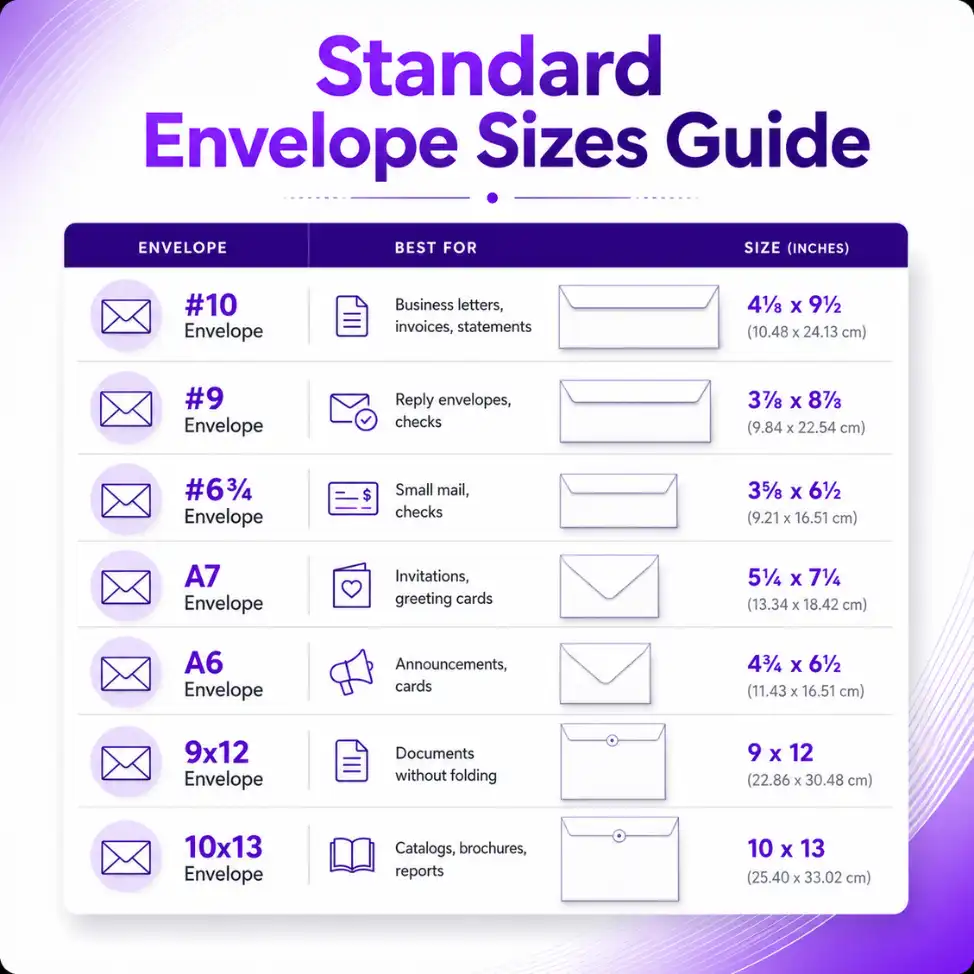
Standard Envelope Size Chart
The following envelope size chart includes common envelope sizes used in the United States for business, marketing, invitation, and document mailing.
| Envelope Type | Size in Inches | Size in MM | Common Uses |
|---|---|---|---|
| #10 Envelope | 4.125″ x 9.5″ | 105 x 241 mm | Business letters, invoices, statements, corporate mail |
| #9 Envelope | 3.875″ x 8.875″ | 98 x 225 mm | Reply envelopes, checks, remittance envelopes |
| #6¾ Envelope | 3.625″ x 6.5″ | 92 x 165 mm | Personal mail, small notices, checks, small inserts |
| A2 Envelope | 4.375″ x 5.75″ | 111 x 146 mm | RSVP cards, small invitations, greeting cards |
| A6 Envelope | 4.75″ x 6.5″ | 121 x 165 mm | Invitations, announcements, folded cards |
| A7 Envelope | 5.25″ x 7.25″ | 133 x 184 mm | Wedding invitations, greeting cards, event invitations |
| A8 Envelope | 5.5″ x 8.125″ | 140 x 206 mm | Larger invitations, promotional cards, announcements |
| A9 Envelope | 5.75″ x 8.75″ | 146 x 222 mm | Half-fold sheets, certificates, marketing inserts |
| A10 Envelope | 6″ x 9.5″ | 152 x 241 mm | Large invitations, direct mail pieces, folded documents |
| 9″ x 12″ Envelope | 9″ x 12″ | 229 x 305 mm | Letter-size documents, contracts, brochures, reports |
| 10″ x 13″ Envelope | 10″ x 13″ | 254 x 330 mm | Catalogs, booklets, legal documents, presentation materials |
These standard envelope dimensions give businesses a reliable starting point. However, for high-volume mailing, custom printed envelopes, or direct mail campaigns, it is always best to confirm artwork setup, postal rules, and insert thickness before printing.
Most Common Envelope Sizes in the United States
Many envelope sizes exist, but a few are used more often in everyday business and commercial printing.
#10 Envelope
The #10 envelope is the most common business envelope size in the United States. It measures 4.125″ x 9.5″ and is designed to hold an 8.5″ x 11″ letter-size sheet folded into thirds.
This envelope is commonly used for business correspondence, invoices, official letters, statements, checks, appointment notices, and direct mail campaigns. Most corporate offices, banks, insurance companies, healthcare providers, and service businesses use #10 envelopes as part of their daily mailing process.
For printing envelopes, the #10 size is also practical because it offers enough space for a return address, company logo, recipient address, postage area, and optional marketing message.
#9 Envelope
The #9 envelope measures 3.875″ x 8.875″ and is often used as a reply envelope. It fits inside a #10 envelope, making it useful for bills, donations, payment returns, surveys, and response forms.
For example, a utility company may send a statement in a #10 envelope and include a #9 return envelope for the customer’s payment. Nonprofits also use #9 envelopes in fundraising mailers to make donor responses easier.
A7 Envelope
The A7 envelope measures 5.25″ x 7.25″ and is one of the most popular invitation envelope sizes. It is commonly used for wedding invitations, event announcements, holiday cards, greeting cards, and premium promotional mail.
Businesses also use A7 envelopes for branded event invitations, corporate announcements, luxury product cards, and thank-you notes. Its size feels more personal and polished than a standard commercial envelope.
9 x 12 Envelope
A 9″ x 12″ envelope is used when documents need to stay flat. It fits standard 8.5″ x 11″ sheets without folding, making it ideal for contracts, certificates, brochures, reports, photographs, and presentation documents.
In packaging and e-commerce, 9 x 12 envelopes are also useful for shipping documents, instruction sheets, return forms, and promotional inserts.
10 x 13 Envelope
A 10″ x 13″ envelope gives extra room for thicker documents, catalogs, booklets, legal paperwork, and multi-page marketing materials. It is often used when a 9 x 12 envelope feels too tight or when documents need more space to slide in easily.
Printers and businesses use this size for catalog mailings, sales kits, press packets, employee documents, and formal corporate communication.
Business Envelope Sizes
Business envelope sizes are designed for professional mailing, office stationery, and corporate communication. The most common business envelope is the #10, but other sizes are also useful depending on the application.
For invoices and statements, #10 envelopes are efficient because standard letter-size paper folds neatly into thirds. Window #10 envelopes are often used when the recipient address is printed directly on the invoice or statement inside the envelope. This saves time and reduces labeling errors.
For checks, remittance forms, and return mail, #9 envelopes are a reliable choice. They are commonly inserted inside #10 envelopes and used by banks, insurance companies, nonprofits, schools, and billing departments.
Legal documents may require larger envelopes, especially when folding is not recommended. A 9 x 12 or 10 x 13 envelope can protect contracts, certificates, signed forms, and official paperwork from creasing.
A real-world example is a property management company mailing lease documents. If the documents are informational, a #10 envelope may work. If the package includes signed contracts, multiple forms, or printed copies that should remain flat, a 9 x 12 envelope is a better option.
Invitation Envelope Sizes
Invitation envelopes are usually selected based on card size, presentation style, and event type. Unlike business envelopes, invitation envelopes often focus more on appearance and first impression.
A2 envelopes are commonly used for RSVP cards, small greeting cards, and thank-you notes. A6 envelopes work well for smaller invitations, announcements, and folded cards. A7 envelopes are the standard choice for many wedding invitations, event invitations, holiday cards, and formal announcements.
For larger invitations or premium event materials, A8, A9, and A10 envelopes provide more space. These sizes are useful when the invitation includes multiple cards, inserts, directions, RSVP cards, or branded promotional pieces.
For corporate events, the envelope should match the tone of the invitation. A clean white A7 envelope with a printed logo may work for a professional seminar. A textured or colored A7 envelope may be better for a luxury product launch or private event.
When printing invitation envelopes, businesses should consider paper stock, flap style, ink color, logo placement, and address formatting. A well-designed envelope can make the invitation feel more valuable before it is even opened.
Booklet vs Catalog Envelopes
Booklet and catalog envelopes are both larger envelope styles used for documents, brochures, catalogs, booklets, and marketing materials. The main difference is the opening style.
Booklet envelopes open on the long side. This makes it easier to insert wide documents, brochures, booklets, and presentation materials. Catalog envelopes open on the short side, which works well for thicker documents and materials that need extra security.
| Feature | Booklet Envelopes | Catalog Envelopes |
|---|---|---|
| Opening Style | Long-side opening | Short-side opening |
| Best For | Brochures, booklets, reports, marketing kits | Catalogs, legal documents, thick packets |
| Insertion | Easier for wide materials | Better for stacked documents |
| Common Sizes | 6 x 9, 9 x 12, 10 x 13 | 9 x 12, 10 x 13, larger formats |
| Printing Use | Great for front-facing designs | Great for formal document mailing |
For direct mail marketing, booklet envelopes are often preferred because the long opening makes assembly easier and allows printed designs to feel more promotional. Catalog envelopes are commonly used for official documents, catalogs, manuals, and heavier inserts.
Choosing the Right Envelope Size
The right envelope size depends on the document, mailing method, printing design, and customer experience you want to create.
Start with the insert size. A standard 8.5″ x 11″ letter can be folded into a #10 envelope or mailed flat in a 9 x 12 envelope. A 5″ x 7″ invitation usually fits an A7 envelope. A catalog or booklet may need a 9 x 12 or 10 x 13 envelope.
Next, consider folding. Folding saves space and can reduce mailing costs, but it may not be ideal for formal documents, certificates, photographs, premium brochures, or legal paperwork. When presentation matters, flat mailing is usually better.
Postage is another important factor. Larger, thicker, or heavier envelopes may cost more to mail. Businesses running direct mail campaigns should test the complete mailpiece before printing thousands of envelopes.
Mailing efficiency also matters. High-volume mailing requires envelopes that work smoothly with inserting machines, addressing systems, postage equipment, and postal automation. Odd sizes, heavy paper, square shapes, and bulky inserts may slow production or increase costs.
Branding should not be ignored. A custom printed envelope can support brand recognition before the recipient opens the mail. Logo placement, paper color, print quality, and layout all affect how professional the envelope feels.
Envelope Sizes for Commercial Printing
Commercial printing gives businesses more control over envelope appearance, branding, and function. Instead of using plain stock envelopes, companies can print logos, return addresses, taglines, campaign graphics, QR codes, promotional messages, and brand colors.
Custom printed envelopes are especially useful for direct mail campaigns. A well-designed envelope can improve open rates because the outside of the envelope is the first thing the recipient sees. For example, a healthcare provider may use a clean #10 envelope for appointment reminders, while a retail brand may use a colorful A7 or 6 x 9 envelope for a seasonal promotion.
Window envelopes are practical for invoices, statements, checks, and official notices. Full-color envelopes work well for marketing campaigns, invitations, product launches, and branded customer communication.
Variety Packaging can help businesses choose envelope sizes, prepare print-ready envelopes, align artwork with postal requirements, and create custom envelope printing that matches brochures, business cards, catalogs, packaging inserts, and other printed materials.
For e-commerce businesses, envelopes are also useful for document packaging. Printed envelopes can hold return labels, invoices, warranty cards, discount inserts, thank-you notes, and product care instructions. This creates a more organized unboxing experience and keeps important documents protected inside the shipment.
Common Envelope Printing Mistakes to Avoid
The most common mistake is choosing the wrong envelope size. If the insert is too tight, it may bend, tear, or create a bulky mailpiece. Always check the document size, fold style, and insert thickness before ordering envelopes.
Another mistake is poor artwork placement. Logos, return addresses, and promotional graphics should not interfere with the recipient address, postage area, barcode area, or mail processing zones. A design may look attractive on screen but fail in real mailing conditions.
Missing bleed areas can also create problems. If artwork extends to the edge of the envelope, the design needs proper bleed. Without bleed, trimming or production movement may leave unwanted white edges.
Low-resolution designs are another issue. Logos and graphics should be high quality and prepared in the correct color mode for printing. Blurry logos or pixelated graphics can make a business look unprofessional.
Postal compliance problems can become expensive. If the envelope is too thick, too rigid, oddly shaped, or incorrectly addressed, it may require extra postage or manual handling. Before printing a large direct mail campaign, review the finished size, weight, thickness, address placement, and postage method.
Envelope Design and Printing Best Practices
Good envelope design balances branding with mailing function. The envelope should look professional, but it must also move through the mail system efficiently.
Keep important artwork inside safe zones. Avoid placing logos, text, or graphics too close to the edge. This prevents trimming issues and keeps the design clean.
Use proper bleed settings when printing artwork to the edge. A printer can provide the correct bleed requirements based on the envelope style, flap, and production method.
Place the return address in the upper left corner unless the design calls for a different approved layout. Keep the recipient address clear, readable, and positioned correctly. Avoid using decorative fonts for essential mailing information.
Leave enough space for postage, barcodes, and postal markings. This is especially important for direct mail marketing, where automated processing and address accuracy affect delivery performance.
Match the envelope to the rest of your printed materials. If your brochure, catalog, business card, or packaging insert uses specific colors and fonts, the envelope should follow the same brand style. Consistency builds recognition and trust.
For print-ready envelopes, use high-resolution artwork, vector logos when possible, correct color settings, and approved templates. Before full production, request a proof to confirm size, placement, color, and readability.
Frequently Asked Questions
1. What is the standard envelope size?
The most common standard envelope size in the United States is the #10 envelope, which measures 4.125″ x 9.5″. It is widely used for business letters, invoices, statements, and corporate correspondence.
2. What size is a #10 envelope?
A #10 envelope measures 4.125 inches by 9.5 inches, or about 105 x 241 mm. It fits a standard 8.5″ x 11″ sheet folded into thirds.
3. Which envelope is best for business letters?
The #10 envelope is best for most business letters. It is professional, cost-effective, easy to print, and commonly accepted for office mailing.
4. What envelope size fits a brochure?
It depends on the brochure size and fold. A tri-fold brochure often fits in a #10 envelope. A larger brochure that should remain flat may need a 9 x 12 envelope.
5. What envelope should I use for invitations?
A7 envelopes are commonly used for 5″ x 7″ invitations. A2 envelopes work well for RSVP cards, while A6, A8, and A9 envelopes can be used for different invitation formats.
6. What is the difference between booklet and catalog envelopes?
Booklet envelopes open on the long side, while catalog envelopes open on the short side. Booklet envelopes are often used for brochures and marketing materials, while catalog envelopes are better for thicker packets and formal documents.
7. What is a #9 envelope used for?
A #9 envelope is commonly used as a reply envelope. It fits inside a #10 envelope and is often used for payments, donations, surveys, and return correspondence.
8. What size envelope fits 8.5 x 11 paper without folding?
A 9 x 12 envelope fits standard 8.5 x 11 paper without folding. A 10 x 13 envelope provides more room for thicker documents or multiple sheets.
9. Are envelope sizes in inches or millimeters?
In the United States, envelope sizes are usually listed in inches. Millimeter measurements are also useful for international printing, design software, and technical production.
10. Can envelopes be custom printed?
Yes, envelopes can be custom printed with logos, return addresses, brand colors, campaign messages, QR codes, and full-color graphics. Custom printed envelopes are commonly used for business correspondence, direct mail marketing, invitations, and branded packaging inserts.
11. What is the best envelope for direct mail marketing?
The best envelope depends on the campaign. #10 envelopes work well for letters and offers. A7 envelopes can feel more personal. 6 x 9, 9 x 12, and booklet envelopes are useful for brochures, catalogs, and promotional materials.
12. Do larger envelopes cost more to mail?
Larger envelopes may cost more depending on size, weight, thickness, and mailing category. Before printing a large mailing campaign, test the complete mailpiece and confirm postage requirements.
Conclusion
Standard envelope sizes play an important role in business communication, printing, mailing, and packaging. The right envelope protects the contents, supports postal efficiency, improves presentation, and strengthens brand identity.
When choosing envelope sizes, consider document dimensions, folding requirements, postage costs, printing layout, branding, and mailing standards. A well-planned envelope does more than carry paper. It represents your business before the message is even opened.
For custom envelope printing, packaging solutions, direct mail materials, and commercial printing services, contact Variety Packaging. The right printing partner can help you select the best envelope size, prepare accurate artwork, improve mailing efficiency, and create professional envelopes that support your brand from the mailbox to the customer’s hands.